
Material for the school
Updated programme
Dogterom lectures, supporting matrial
Slides from lectures: 1, 2, 3, 4, 5
Problem class: Article to read and associated problems.
Prost lectures, supporting matrial
Problem class: Articles to read and report on for group 1 (Asti-Farrell), group 2 (Foret-Oppenheim) and group 3 (Oriola-Zou). "Please consider the virtues of these descriptions & caveats, criticisms, limitations, extent of universality..."
Nelson lectures, supporting matrial
Altan-Bonnet lectures; supporting material
Document in lieu of lecture notesTwo classical papers
Systems Immunology circa 1958 (first proof of single-receptor expression on lymphocytes): Nosal & Lederberg Nature, 1958
Kinetic proofreading applied to TCR signaling: McKeithan PNAS, 1995.
Shraiman lectures, supporting matrial
Problem class: Articles to read and report on for group 1 (Asti-Farrell), group 2 (Foret-Oppenheim) and group 3 (Oriola-Zou)
Cavagna lectures, supporting matrial
Problem class "Border effects in collective behaviour": 1. What is r_1(N) at fixed density? 2. What is \gamma(1) near the edge of a flock with the mean velocity normal to the interface? 3. What is \gamma(1) near the edge of a flock with the mean velocity tangential to the interface?
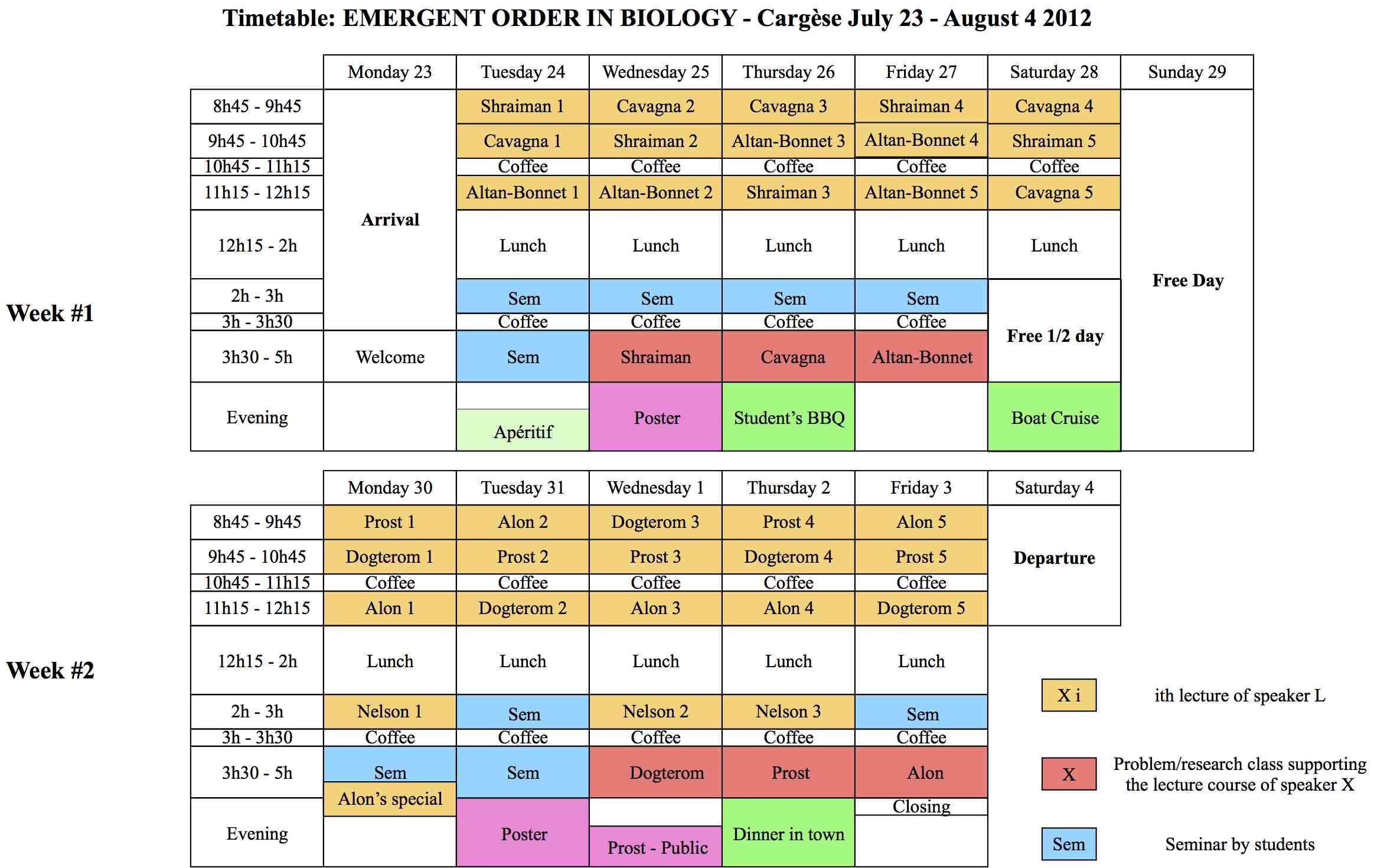
Updated timetable
Emergent order in Biology 2011
Complex, non-equilibrium phenomena in living systems are currently of great interest to researchers with backgrounds in a number of traditional and non-traditional disciplines. These include soft matter physics, quantitative and systems biology, mathematical biology and the experimental biosciences, amongst others. To understand the way in which complex behaviour and order typically emerges from a large number of smaller interacting subsystems we need to make progress both on solving (and posing) formal problems and on understanding experiments. The present workshop will focus on this question under the title emergent order in biology. The aim of the workshop will be to present the state of the art of our understanding of a number of rapidly evolving fields and to promote discussions and interactions between participants. Details of the program are now available.
Workshop Venue and Format
The school will be held at the Institute d’Etudes Scientifiques de Cargèse, an Institute specially constructed for this type of meeting.
The institute is located on the seashore of the island of Corsica, 50 km north of Ajaccio. It is located close to the beach at walking distance (20 min. via the main road, 15 min. via a 'goat path', bring good shoes) from the village of Cargèse. Lunch for all participants will be served at the Institute.
Sessions will start on the morning of Tuesday, July 24th and end in the afternoon of Friday, August 3rd. Participants are expected to arrive on Monday, July 23rd and leave Cargèse late on Friday, August 3rd (or on Saturday morning).
Participation
The objective of this summer school is to bring together PhD students and young scientists whose research aims at understanding emergent order in complex biological systems. We would like to provide them the opportunity to attend focused courses starting at a tutorial level but allowing to reach the state of the art in this field, both on theoretical and experimental aspects. The format of the school will also give attendees the opportunity to present their research, hopefully providing useful feedback and advice, including on possible future directions for their research. We also aim to offer young scientists the opportunity to promote and discuss their work and exchange views with experts. We envision approximately 60 to 80 participants from the international community, including lecturers and guest speakers.